"Not Just Recognition, but Shame": Abdulrazak Gurnah on Berlin's Colonial Past
Nobel laureate Abdulrazak Gurnah talks to HEIST about colonialism's afterlife in Berlin, museum basements and the story of Bayume Mohamed Husen.
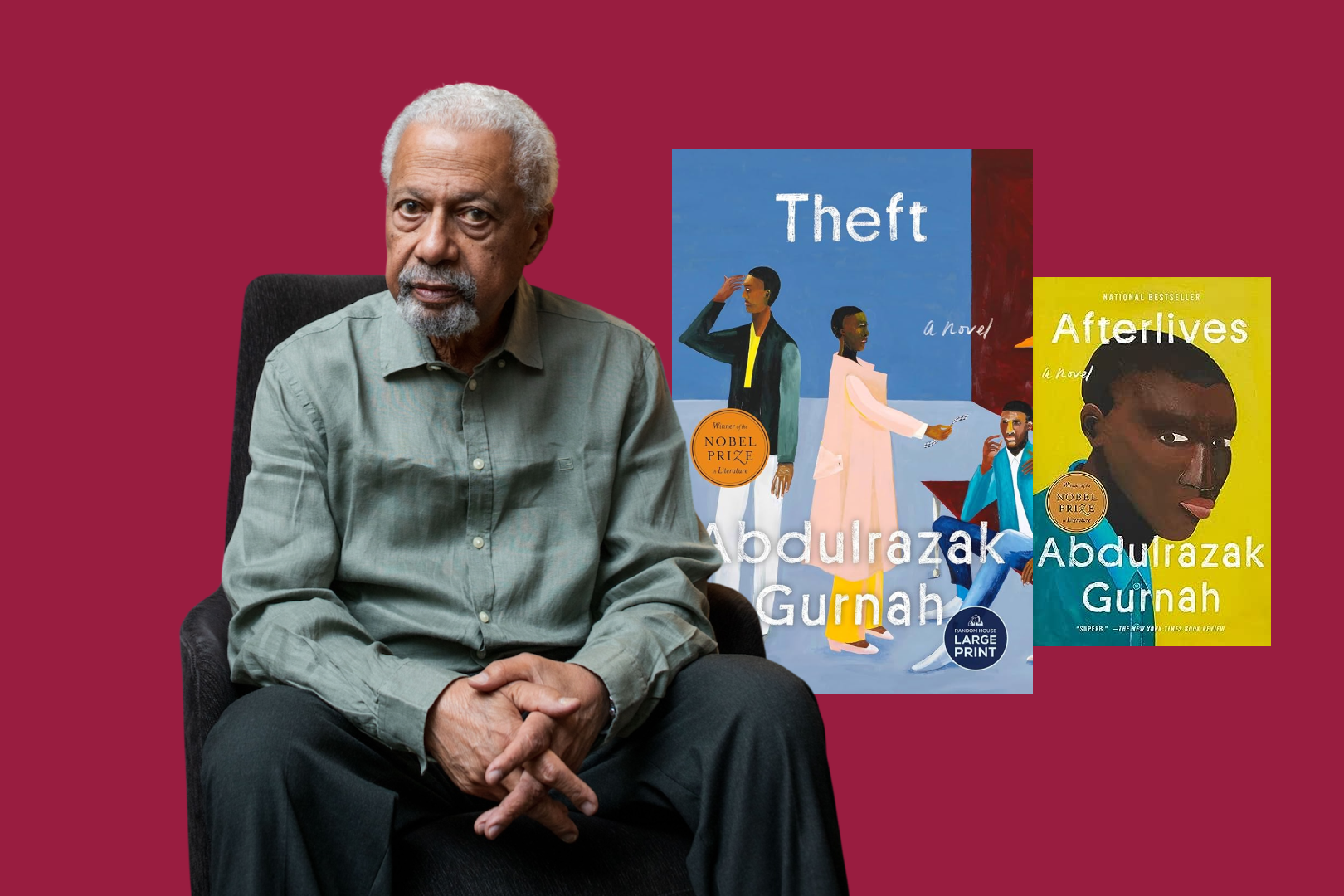
Abdulrazak Gurnah is a writer of great precision and great patience. Born in Zanzibar, part of Tanzania. In 2021, he received the Nobel Prize for Literature - awarded, in the Swedish Academy's words, for his "uncompromising and compassionate penetration of the effects of colonialism and the fate of the refugee."
As well as touching on the issue of the colonial-era human remains which are still scattered across Berlin's museums, we talk about the case of Bayume Mohammed Husen, a fascinating historical figure who served in the Schutztruppe, the German colonial army, before coming to Berlin, where he worked as an actor and appeared in Nazi-era films. He was eventually arrested by the Gestapo and died in Sachsenhausen concentration camp in 1944. It's a story Gurnah refracts through the character of Ilyas in his novel Afterlives.
But we begin somewhere else: with the concept of cosmopolitanism. This is an important idea for Gurnah, for whom it does not mean just worldliness or looking out at the world from some assumed centre. Instead, he thinks about many centres: the Indian Ocean, Central Asia, the Middle East, and how each of these has been a place of exchange, transmission, and encounter for as long as Europe has. The difficulty of seeing this, he suggests, is not just an intellectual failure, but a kind of historical blindness that we are still living with in the west.
You grew up in Zanzibar, today part of Tanzania. I remember an anecdote about how, when you were young, you found shards of ancient Chinese pottery – and it gave you a sense of the interconnected histories all along the Indian ocean. I wonder if you feel that European cities – like here in Berlin - can become somewhat blinded by their own sense of being in the centre?
Well, you could put it like that, although that sounds like you're picking a fight with Berlin. But I would say that way of thinking continues the normative idea of the world as something which pulses from Europe to the periphery. Of course, in terms of power or prosperity, that is probably largely true, at least until recently. Though now we have China.
When they finally defeated him, and captured him. They cut his head off and brought it back.
But there's another way of looking at this, whereby you do not need to talk in terms of periphery and centre at all, but to understand the idea of what might call the cosmopolitan. The more familiar, the Western explanation for this idea is of people in the West taking an interest in other parts of the world, and therefore they become more worldly. So cosmopolitan, the world city, as it were. But what that assumes is that there is indeed a center. There is a place where the core of human culture and civilization emanates into the wider world. Whereas perhaps it's more correct, I think, to understand that there are several cosmopolitanisms, several centers of exchange, transmission, historical and contemporary relationships. You might say, for example, the Middle East is one of those, where different cultures, different religions, different ethnicities have been, well, bickering a little bit, but also living together for a long time. Or you could think of the Chinese cosmopolitanism, the Central Asian cosmopolitanism, or indeed that of the Indian Ocean. These are places that have their own sense of who they are. It doesn't rule out the possibility of engaging with other centers of knowledge, but they’re not completely deferential towards a more superior epistemology, a more superior culture.
It's very difficult to step out of that, if you're used to thinking of yourself in that way. And this is the bind, I suppose, that a lot of Europe is still in: how it regards itself and how it regards the world. And of course, not just Europe, but North America as well.
Did you always have that sense of cosmopolitanism, or was it something which came later?
No, that kind of self-awareness is not available to, let's say, a teenager or even perhaps a young person. It comes with a greater understanding of where you are in the world. Most of the time people are not self-consciously asking, “where is my center?” They've got more immediate anxieties. For myself, growing up, I was happily unaware that somebody thought that I was on the periphery of anything. I just thought I was where I was. Those questions came later. “How do I relate to this place. Who am I? How do I relate to where I come from?” I think that when people travel from their origins, it accelerates or exacerbates that sense of self-inquiry.
There are traces of Tanzania here in Berlin, physical objects extracted during German colonialism. One such item is the giant Brachiosaurus dinosaur in the Natural History Museum. Do such items in any way complicate your relationship to a city?
Not for me. The fact that something is here in Germany, in the Humboldt Forum, or in the British Museum, or whatever: it isn’t that important. The crucial thing is the impulse that made this transaction happen. You mention the dinosaur, but I would have thought the most sensationally outrageous items that were brought back were the human remains. And [they were brought back] not always for scientific reasons either. I mean, that was the ostensible reason. But quite often, there were trophies of war. For example, the leader of the Hehe people in Deutsch-Ost Africa.
You’re talking about Mkwawa.
Mkwawa, indeed, who gave the Schutztruppe a great deal of trouble. But when they finally defeated him, and captured him. They cut his head off and brought it back.
This is not to do with science. This is a kind of vengeance. And there are many other trophies like that, not only in Deutsch East Africa. In Africa, there is Namibia, Cameroon, and Togo. Atrocities of an equally outrageous nature happened in those places as well. And the remains were brought back here. So, it's the impulse that makes an impact on me, rather than where they have put them.
Freud uses burial artefacts as a metaphor for repression: when you bury something underground, it becomes preserved, unchanged. Considering these thousands of human remains stored in museum basements, I wonder whether you think that Europe continues to have a repressed attitude towards its colonial history.
Definitely, but I don't think those remains are indicative of it. I suppose they would quite like to bury them now, but they're here, they're on display. If you go to the Humboldt Forum, you can observe them. It's not that they're hidden anywhere.
This is not to do with science. This is a kind of vengeance
I believe the human remains are no longer on display. There's plenty of other... trophies, you could call them, from all different contexts and expeditions. But, on the whole, the museums have made a decision to hide the human remains, to put them in the basement.
So perhaps the practice is being modified. But this colonial attitude was not only towards Africa. But I remember visiting the Natural History Museum of the University of Oklahoma. It's a library, really. And there are stacks with the human remains of Native American people who were displaced from there. And they are all dated, all those boxes. I suspect they, too, are in a basement now. And what that indicates, it seems to me, is a kind of not just recognition, but shame at the knowledge that this is what we've done. That it isn't something that can be explained away.
I’m interested in some of the complicated histories embedded in your work. In Afterlives, you rework the story of Bayume Mohammed Husen. He fought in Tanzania as a Schutztruppe, on behalf of Germany, and later came to Berlin. He worked in a nightclub, not too far from where we’re talking. Later, he became an actor, appearing in Nazi propaganda films. Finally, he became a victim of the regime himself. What drew you to that story?
The idea which interested me was of people who become mercenaries for the colonial armies. Not just in this war, but also for the British, for the Portuguese, for the Belgians. One of the questions that I was interested in investigating in Afterlifes is,: how did people explain it to themselves? What did they think they were doing? What would make somebody become a mercenary of a force that is oppressing your own people? And one of the things I came to understand is that often they were not their own people. They did not think of them as their own. The idea of an African was not there at the time. People thought of themselves differently, in more precise, or more local, senses.
Then, as I was doing my reading, I ran across a footnote. A reference to this person who became an actor. This was the first thing that I saw. A person who was a Schutztruppe and then became an actor. I read a little bit more and found a very interesting history. He was not Tanzanian or Tanganyikan - those words, in fact, didn't exist at the time - he was Sudanese. And this is the connection between the Schutztruppe, the Sudanese, and the British. Nubian people became mercenaries for the British against the Mahdi in the late 19th century. They’re demobbed in Alexandria. When the [German] Colonel Wissman is looking for mercenaries, he goes to Alexandria, recruits them, and takes them to Deutsch Ost Africa. So, they're there as a foreign army, in a sense. And he's a descendant of one of them. So that complicates it. It's not just simply a Tanzanian, which, as I say, didn't exist. He's part of something completely different.
You might think he's kind of revivified by his connection with Germany. It's the Germans who give him a life, who pick him out of misery in Alexandria, make him a sergeant. At least, I think he was some kind of NCO. He's German in his heart. They are his saviors.
And then they kill him.
You give that final period of his life a very condensed treatment. We learn about it only through the character of Ilyas – that period when Husen would have been performing in Volkeschauen, displays of peoples from different parts of the world.
Well, I didn't want to write a historical story. I wanted a figure, and so I made him a musician. But the picture that I described, which the young Ilyas, the budding journalist, takes for his project: that is a real picture of Husen. He is standing on stage with the big swastika flag behind him, with a young man in Lederhosen on one side, another man with an armband and the brownshirt uniform on the other side.
National narratives... introduce a protocol to say: this is what you must not say, this is what you must not think.
Husen is commemorated with a Stolperstein in Berlin. And his life story brings together those periods of German colonialism and the holocaust. I wonder if you think that Germany’s colonial memory was eclipsed by Nazism, or if there’s a way to see those two histories in relationship with each other?
It seems to me understandable that it would recede a little bit in the memory, that the events from the 1930s onwards quite rightly occupy the minds and the anxieties of people over the next years. Germany had ceased to be an imperial nation in 1918. But what didn’t cease – and is perhaps forgotten – is that the reclaiming of the colonies was part of the Nazi platform. So, it would have kept bubbling, that desire. Now, the connection has been made, particularly by Hannah Arendt, but also by others, that the earliest lessons the Nazis draw upon arise from of the experience of colonizing and subjecting others.
But the British and the French, the Portuguese and the Spaniards had been doing it for centuries before Germany joined that overseas business. So I can understand perhaps, after the events of the 1930s and 1940s, if the memory seems a long way away. I’m not saying its OK, but you can see why. You can't make the same excuse for the French and the British, though. They don't have this big guilt as a result of the Second World War. But they're just as happy to suppress the memory, or to retell the experience of colonialism in ways that suit them. The issue that you're raising is: why do they not remember? But that's how national memories work. They suppress shameful events, and foreground the aggrandizing, the self-aggrandizing.
Do you feel that your work acts against that impulse, that the singularity of the stories works against that idea of grand narrative? Or is that saying too much?
No, that wouldn't be too much. Of course, if you use grand narrative, you immediately start thinking of postmodernism, and I don't operate with that sort of refusal.
But the point about national narratives is they don't just tell a story, but they introduce a protocol to say: this is what you must not say, this is what you must not think. And a lot of writing that we value does precisely the opposite to that, it refuses any national protocol. Sometimes people say that they need to go away in order to be able to write. Well, it's not just the distance. Leaving somewhere can be a way of refusing the everyday sense of being oppressed by what can and what cannot be said.