Vivantes Hospital Workers Strike For Equal Pay
On Wednesday morning, the workers responsible for cleaning, sterilising, and doing maintenance at eight of Berlin’s hospitals launched an indefinite strike.
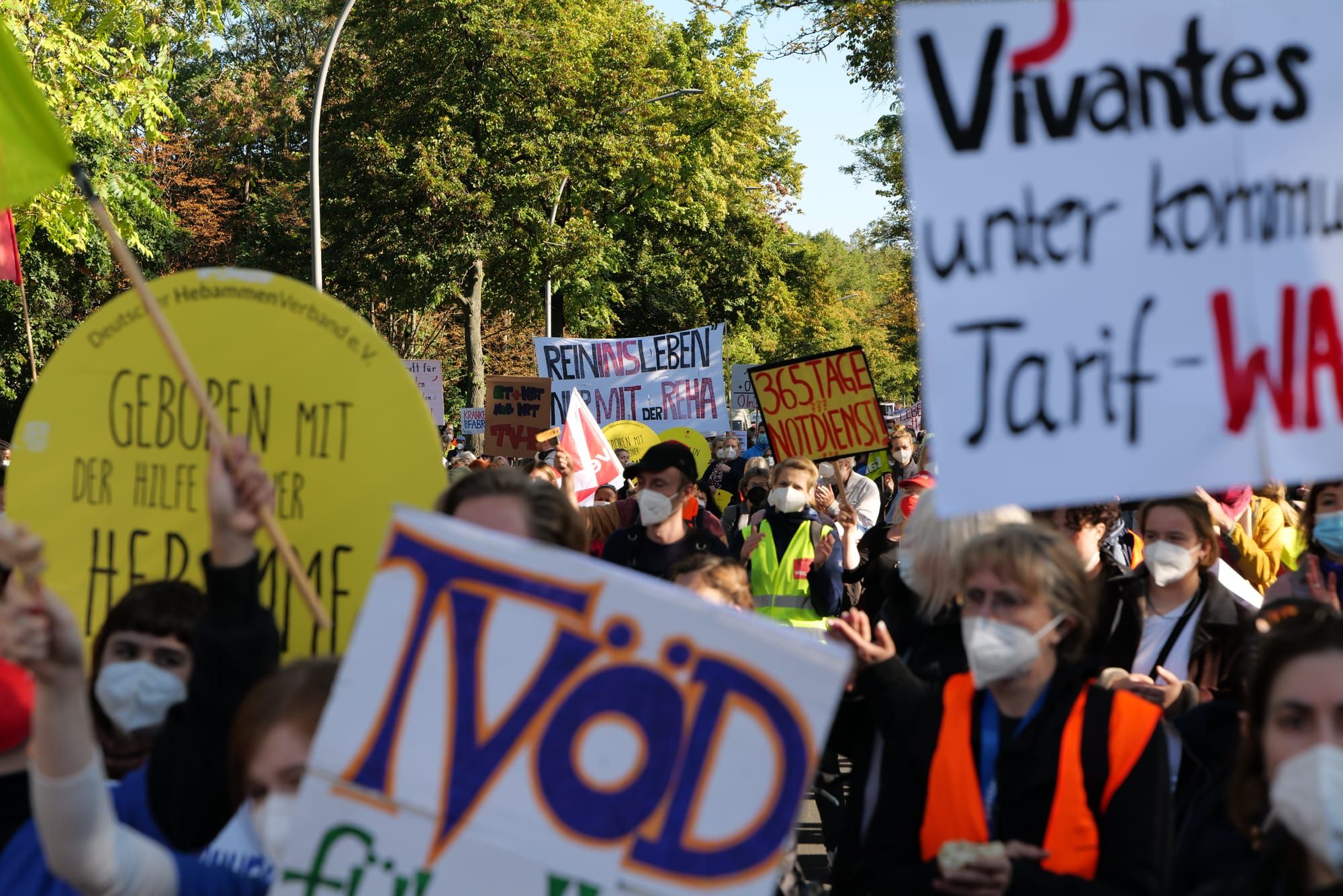
Got elective surgery coming up? You might want to postpone.
On Wednesday morning, service workers at Berlin’s public hospitals — known as the Vivantes network — launched an indefinite strike. These aren’t the doctors or nurses, but the overlooked employees who keep a hospital running: cleaning rooms, transporting patients, serving food, sterilising instruments, doing maintenance. And they want decent pay.
With eight large clinics across the city, Vivantes is Germany's biggest hospital system, serving almost 750,000 patients per year. Just over 20,000 Berliners work there, and their pay is regulated by the Collective Agreement for the Civil Service (TVÖD), the union contract for over two million public-sector workers. Except for the roughly 2,500 service workers, that is. Hence their demand: “TVÖD for everyone on the Spree!”
Once, these labourers were employed directly by the hospital. But in the mid-2000s, in the wake of Berlin’s debt crisis, they were pushed into a jungle of subsidiary companies with adjacent names like VSG, VivaClean, SVL, and more. This was little more than a dastardly accounting trick to lower wage costs by kicking people off of union contracts — and employees, across the many municipal companies that pulled this move, from the BVG to the Technikmuseum, have been fighting to reverse it since.
"It's a question of principles," said Robert Dahms, who works in the sterilisation department of Clinic Neukölln. By cleaning operating instruments, he’s literally keeping people alive — but he still has to worry about keeping himself alive until the end of each month. "Other hospitals pay TVÖD wages to sterilization workers," Dahms told HEIST. A few of his colleagues with old contracts get around €400 more each month, and the department has a hard time hiring. “We have trouble finding new people because of the low wages and precarious conditions; also because it's hard to find an apartment with our salaries.”
Anika Rzepka has worked as an electrician at Vivantes for 16 years, but is technically employed by VSG. For her, this strike is about the dignity of labour. "We want to show that you can have a decent life as a worker, but only if we get organised," she said. "You don't need to invent some kind of app."
Rzepka has a few colleagues with old Vivantes job contracts from before the outsourcing. She makes around €3,600 per month before taxes, but calculates that they get €600 more for the exact same work. The slogan that today’s strike takes as its rallying cry — “Equal pay for equal work” — was coined by 19th-century suffragettes fighting for the rights of female workers in the US. And in Berlin’s hospital system, inequality remains the norm. As in most precarious jobs like cleaning, the Vivantes service staff leans both female and immigrant. Patriarchy and racism guarantee cheap labour.
We'll probably have to strike for many weeks before the Senate realises that nothing in a hospital works without us.
In a press release, Vivantes reminded the public that it ran a deficit of €120 million last year — and three of its Berlin clinics are in bankruptcy proceedings. Yet Vivantes found enough cash to give its CEO, Dr. Johannes Danckert, a salary of €417,000 last year, according to the Kurier. At a time when the German government plans to spend €200 billion a year on new weapons, it's not clear why there's supposedly no money for equitable pay in the capital’s hospitals.
In late March, about 300 Vivantes service workers went on a two-day warning strike. Vivantes has since offered to bring employees up to the same level as TVÖD wages by 2029 — but service workers would be missing out on important benefits, especially pensions, and would still remain outside of the union contract, cutting them off from future raises. This is why 98% of union members voted for the indefinite strike beginning today.
"We won't strike for one week or for two weeks," said Halvard, a Vivantes cleaner identified by his first name, in a clip on Instagram. "We'll probably have to strike for many weeks before the Senate realises that nothing in a hospital works without us.”
As far back as 2016, Berlin's government promised to end outsourcing and reintegrate the myriad subsidiaries as hospital staff. Yet as several Regierende Bürgermeister from the SPD and CDU came and went over the last decade, nothing was ever done.
Lots of these “daughters,” – as subsidiaries are called in German – have gone on strike in the past. The CFM — a company created to cut wages for service workers at the Charité hospital — was on strike for 11 weeks in 2011. After another 45-day strike last year, CFM workers are now set to get TVÖD wages by… 2030. That amounts to two decades of unfairly low wages.
We want to show that you can have a decent life as a worker. You don't need to invent some kind of app.
The Vivantes strikers have reason for hope, though. Workers at Berlin's Botanical Garden, outsourced in a subsidiary called BGBM, fought for two years — and were finally reintegrated into the same staff as their colleagues in 2018. Vivantes and Charité therapists, once outsourced into their own subsidiaries, were also reintegrated into the hospitals after successful strikes.
In the meantime, service workers will see some strike pay from Ver.di — but it's so low that many of them cannot afford to stay out for long. Organisers have set up a strike fund, which has seen over €10,000 in donations so far. Every additional €10 can keep a worker on the picket line for one more day.
Die Linke has a special responsibility, too, and not just because their brand is fair pay. Harald Wolf, a Die Linke member who served as Berlin's economics senator in the early 2000s, was responsible for the massive outsourcing program 20 years ago. It would up the party’s credibility if members of the Bundestag each donated a few thousand euros to right that wrong.
Individual Berliners are also invited to show up in solidarity at the picket lines. Workers are protesting at their clinics beginning around 6:00, and there are often demonstrations or assemblies around 10:00. Vivantes service workers report feeling invisible, and told HEIST that showing up with words of encouragement can mean a lot for morale.
Ultimately, a strike at a hospital is not about the narrow interests of the individual workers — it's about providing health care for everyone. Without these service workers, a lot more Berliners would die from the infections that spread easily in hospitals. Mayor Kai Wegner (CDU) bears full responsibility for this strike, which is fundamentally about public services in Berlin. In the run-up to September's elections, everyone should be thinking about that.