“I am not censoring myself at all”: Mudar Al-Khufash at the Berliner Ringtheater
Palestinian-German artist Mudar Al-Khufash brings his lecture-performance Dialectics of Erasure to the Berliner Ringtheater. It runs through Sunday April 19.
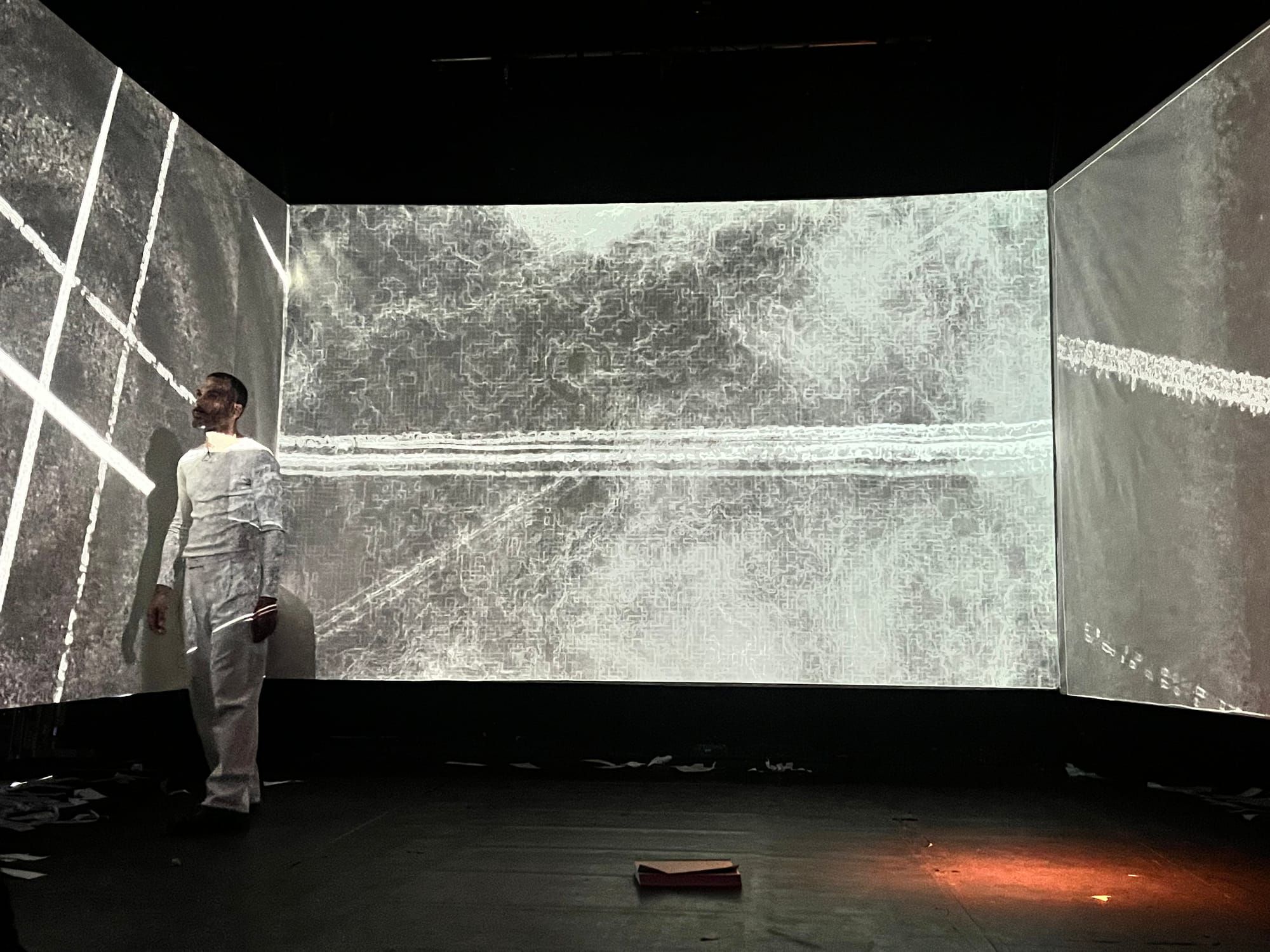
Everyone knows that Berlin’s theatres have been inhospitable to Palestinian perspectives since October 7. Which makes it all the more notable that Mudar Al-Khufash, the Palestinian-German academic and performance artist, will be staging his Dialectics of Erasure at the Berliner Ringtheater from Thursday through Sunday.
Originally conceived in 2025 as his master thesis, the piece started as a site-specific performance on Ives Street in London — the exact spot where, in 1987, the Palestinian political cartoonist Naji al-Ali was assassinated. That participatory lecture has been reworked over the last year for Berlin, and attempts to view settler colonialism not as a historical event but as an ongoing, everyday reality.
The play is broken up into two halves. First the audience will receive instructions for them to act as they move through an undisclosed location near the Spree. Then, they will return to the theatre, where Al-Khufash will offer a reflection on the experience, followed by an open discussion. Tickets are almost completely sold out.
On the eve of the final rehearsal, HEIST caught up with Al-Khufash about the origins of the performance, the difference in thinking about Palestine in London and Berlin, and what it means that this work was funded, in part, by the Berlin Senate.
HEIST: How would you describe your work during this moment, in the shadow of the genocide?
Al-Khufash: What drives me is to share knowledge. I like to do it using creative or artistic methods. If the point of genocide is to make us stop living, then settler colonialism wins, right? Like all these people who got shot or killed or sentenced to prison just because they drew cartoons or wrote a poem. Do not underestimate what this work of an artist does. Look at Israel and how much Israel invests in soft power – all the whitewashing, all the pinkwashing. Look at the silencing here in Germany. It is effective.
I’ve lived in Berlin since 2006. And the word, the ‘P-word,' – if you mentioned it in the room, people would clutch their pearls. That changed a lot over time during the genocide. Now there’s this space for us Palestinians who have been doing art on this. People want to know. And I had this conflict with myself. I don’t want money for this. I was asked to present films or participate in panels. My god, it took a genocide for people to want to know what's going on or what our experience is like. So I do the work anyway. Not because the conditions are right, but because sharing knowledge is what I do. I take the funding because the work needs to exist, not because the state supports me.
You performed a version of this work in London. How did you have to think about the performance differently for Berlin?
The site in London was very powerful. We stood exactly where Naji al-Ali was assassinated. The moment I revealed this, that really resonated with people. That's something they also expressed in the discussion after the performance – anchoring the performance in such a site is its own powerful anchoring of the argument of the thesis. In Berlin, there are many sites of erasure. What I faced, honestly, in the production and logistics, is that none of these sites are close to the theatre. I had to think a bit about “How can I also anchor this project in any city that has the presence or influence of settler colonialism?” In Berlin, I couldn't rely on a single location, so I shifted the site of erasure into the participatory game itself.
Is there a difference in how you can talk about Palestine in London than here in Berlin?
In London, I was less concerned about what I'm going to say, because in London the consensus is with the Palestinian cause. So I had less concerns regarding consequences. But here, I have that layer to think about: “Okay, I need to watch out a bit more." Not because [of] myself, [but] because there are many people involved in this project. It's not just about me. There's a theatre. There are all the artists who also co-created this piece.
How do you see the role of the audience in this performance?
What I aim to do, basically, is to get the people not to only spectate, but also to take a role and to co-author and be part of the experience themselves. Get them into that visceral moment where complex topics will become tangible, which I'll be sharing with them through some participatory interaction. They will rehearse dynamics that exist in our daily lives. I’m not trying to reclaim a metaphor, but I really want to really make people understand these roles before we go into the lecture and discussion segment.
My god, it took a genocide for people to want to know what's going on or what our experience is like.
Is there hope? Do you see some sort of opening occurring – or are we in a moment of ongoing erasure? How do you think about the presence of Palestinian art and Palestinians in this city in the near future?
It absolutely is a dialectic, right? It's not monolithic. Even with my higher education in Germany, in both universities—at UDK and Humboldt—every time I presented a project or an essay or Hausarbeit, because I always presented work on Palestine, my worry was, ‘Oh, it's about Palestine. How is the professor going to react to this? Are they going to say no?’ Not ‘if the point is coming through,’ not ‘if my argument is making sense?’ I was more concerned how I'm going to defend that I am Palestinian.
I was very, very surprised, more so at Humboldt in cultural studies, how the professors, privately, were very receptive of the work. I'm not bragging. I'm just saying that getting a 1.0, the highest mark, from a German professor when writing on Palestine, that's not what I thought [would be possible]. But publicly, I can't imagine a professor speaking or defending the work, right? So, I am funded by the Senate. At the same time, I'm still expecting scrutiny. I am going into this project knowing that this will happen. I'm not censoring myself at all. So yeah, this contradiction definitely exists. I get funding from a state that clearly does not support Palestinian perspectives. In the near future, I think Palestinian art will stay precarious but irrepressible. More artists will learn to work within the contradictions, and some institutions will fund us while others exclude us. The erasure will not stop, but neither will the presence.
- Dialectics of Erasure, April 16-19, Berliner Ringtheater, details here