The Romanisches Café: Weimar Berlin's Lost Laboratory of Ideas
Once the nerve centre of 1920s Berlin, the Romanisches Café drew writers, exiles, and avant-garde artists from across the world - until the Nazis erased it.
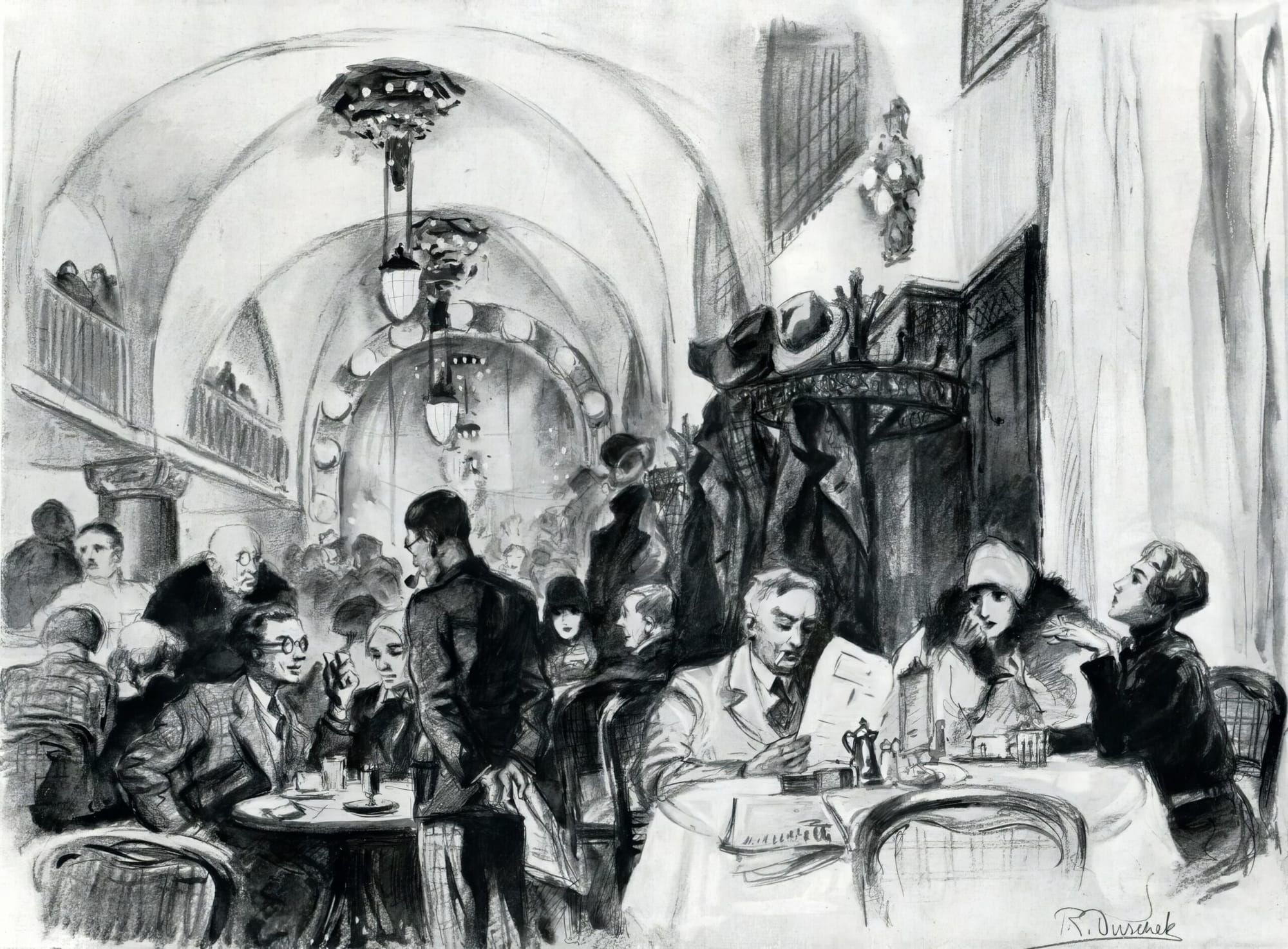
If there is one site that captures the creative energy of Weimar Berlin, it is the Romanisches Café. The place was legendary, and has been mythologised in countless memoirs of the time. All of the most celebrated writers and artists were there, many of them with their own dedicated table. As the theatre critic Hans Sahl once recalled: “There was a sculptor’s table, a philosopher’s table, a stock exchange courier’s table, a table for critics, dramatists, essayists, sociologists, and psychoanalysts.”
And yet there is very little of the café remaining in Berlin today. In fact, the café died twice: its creative spirit was drained after the Nazis came to power in 1933 and drove its regulars into exile or to their deaths, and then the building itself was destroyed in an Allied air raid ten years later. After the war, what remained was demolished, and its legacy at least partially forgotten.
Katja Baumeister-Frenzel has sought to change that. Since January 2024, she has hosted an exhibition inside the Europa-Center — on the exact spot where the café once stood — which has so far drawn around 50,000 visitors. Now, with English-language tours launching on 28 June, she is making the story accessible to an international audience. We caught up with her to revisit the story of Berlin's lost laboratory of ideas.
Tell us about the Romanisches Café This was a place whose regulars included Walter Benjamin, Elias Canetti, Irmgard Keun, George Grosz, Else Lasker-Schüler. What was it about this spot that drew so many remarkable people?
There were always intellectual und bohemian groups meeting up in cafés in Berlin, and over time the cafés changed of course. Right before the Romanisches Café became the hotspot of intellectuals in the 1920s, the Café des Westens, located where Café Kranzler is fighting for a meaningful reanimation today, was the place to be. It hosted the intellectuals and bohemians during the Kaiser period. Later the Café des Westens tried to improve themselves with a renovation and a changed business plan; they wanted more entertainment and more tourists, who actually ordered more than just one cup of coffee.
The Romanisches Café never really changed that much. It was still an old-fashioned café, where you were supposed to read the paper — there was this huge newspaper shelf — and no entertainment, no music, no dance, no evening show. I think that was very helpful for the café to become the spot where all the intellectuals came to mingle, because many of them really did work here. They would work on their projects — a play, a book, a film, a painting, music, a book. And if you were single in Berlin back then and you maybe rented a room from a landlady, oftentimes you were not even allowed to have visitors in your room, especially not from the opposite sex. Still you had to accomplish your work with your peers somehow, and renting an office was of course not available to everybody. Cafés were always a good place to get together and work. On top of that it must have felt like an ever ongoing networking event.
It was a very busy phase during the 20s for the intellectuals, censorship was not as rigorous as it was during the Kaiserreich anymore and a lot of plays, books, ideas and movies etc. could finally be realized. For any project you also had to acquire money and for that you had to broker your idea or yourself and pitch your project to a wealthy friend of the arts, which you could also meet at the Romanische Café.
Take us inside the space. What would it have felt like to walk in and spend an afternoon there?
The Romanisches Café was actually just a regular Café at the center of the fashionable district called the “New West” around the Kaiser-Wilhelm-Gedächtnskirche. It was a place for everybody. If you wanted to, you could just go there — you did not have to be famous to go to the Romanisches Café.
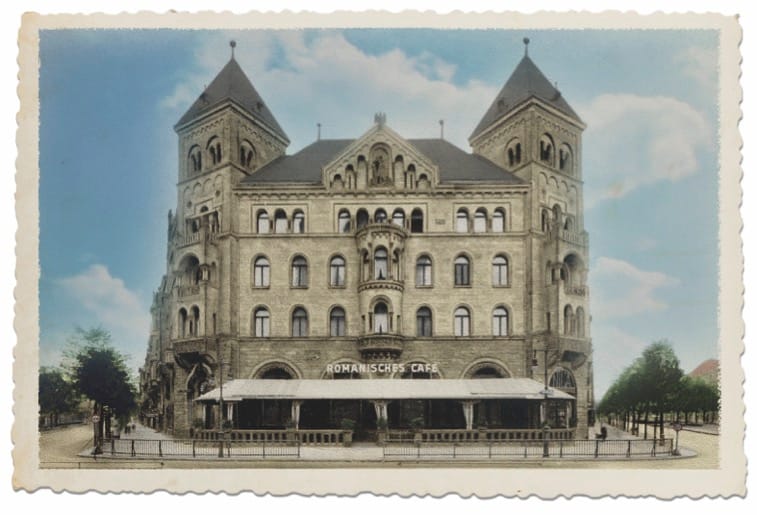
For many it was used as something as a co-working space. Everything you needed was already there. There was a waiter whose job it was to distribute the vast amount of daily newspapers, he would also bring you ink and a pen, if needed. We know that the Café also served as a mailing address for some of the guests. The Café had telephones for outgoing and incoming calls. And, very importantly, the Brockhaus encyclopaedia at hand, in German and in English.
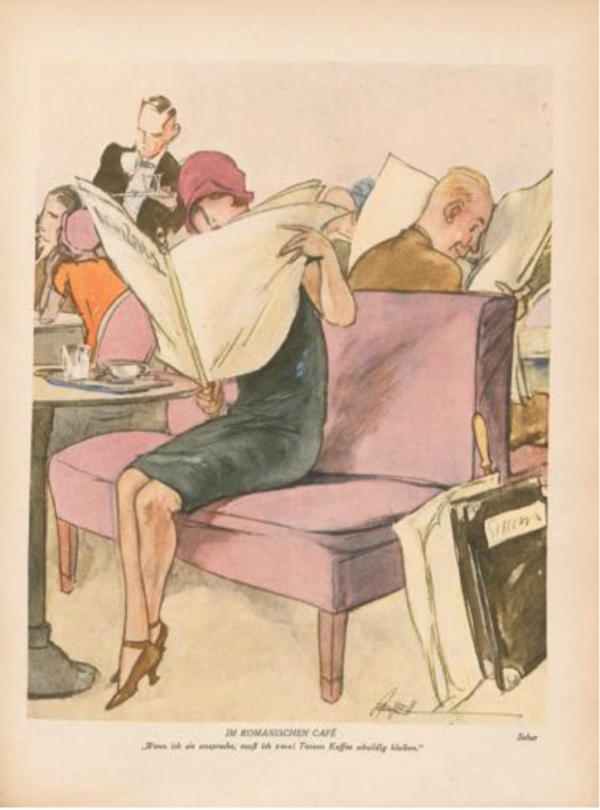
There were never more daily newspapers published in Berlin than during the 1920s. To be well informed you had to read many of them plus the ones from other cities and the international ones, many of them were provided to you at the Café. Well known reporters and journalists, like Egon Erwin Kisch, and publishing houses like Ullstein had their Stammtische, their regular tables at the Café. So the newspapers were read here, at the same time many of the articles also came to their existence here. There was a variety of regular tables, not only for the journalists but also for different professions like artists, writers, lawyers, doctors and more. The established regulars sat in what was called the pool for swimmers, and the younger, less established ones waited in the pool for non-swimmers, hoping to be noticed. In 1928 there was an upstairs gallery and an extra room added for the many chess players. Emanuel Lasker, who was world champion for something like ten years, wrote a book on chess that's still in stores today. He played here as well as the young and already famous Bertolt Brecht.
What you did not do was eat at the Romanische Café. Of course it served all kinds of beverages like coffee, tea, liquor, beer — and basic food: Schnitzel, Boulette, Kartoffelsalat, and a simple typical Berlin dish, Eier im Glas, boiled eggs served in a glass with butter or chives. But when you read the accounts, many of the guests say that the food was nothing to write home about. The guests that could afford to, when business and all talks were done with at the Romanisches Café, went on to eat at Schwanecke, around the corner on Rankestraße.
Ilya Ehrenburg described the café as a headquarters for people "entirely cured of narrow-minded nationalism" — Jewish, multilingual, internationalist, welcoming to women. Was it essentially a progressive space, and was that part of what made it a target?
Many Jews from all over the world came to Berlin as a safe haven. Especially after the Russian Revolution in 1917 there were also many Russian migrants. The Romanisches Café welcomed Jewish intellectuals, all sorts of émigrés, avant-garde artists, as well as politically unconventional figures, independent women and queer people. In some ways it was a safe space for otherwise marginalized groups or individuals and like a rehearsal stage for new and unconventional ways of living and identities. Furthermore it was a place for modern ideas and for international exchange and a realm for the established bourgeoisie of Charlottenburg.
In the Nazi press not only the visitors of the Café, but the entire neighborhood around the Kurfürstendamm was identified as exactly the kind of place and the kind of crowd the Nazis despised for being decadent and un-German. With their antisemitic propaganda they also targeted the many jewish and jewish-decent residents and business owners of Charlottenburg.
The end came quite deliberately. After 1933 the regulars were deported, driven into exile, or took their own lives. Wolfgang Koeppen described a kind of zombified afterlife. Do you tell the story of both phases? Is the Romanisches Café ultimately also a portrait of what the Nazis destroyed?
We tell both, and you can't do otherwise. It's impossible to understand the Romanisches Café without confronting the violence that ended it. In the exhibition we place particular emphasis on the period before 1933, as our aim is to tell the story of what was lost.
After the Nazis took power in 1933, everything was over right away. The Nazis moved in and established their own tables at the Café. Many of the regulars were targeted, they saw their books being burnt, their freedom of expression extinct. Many of them went into exile, others were persecuted, imprisoned or killed. A part of the Café was eventually turned into a beerhall. A newspaper-article from 1939 celebrates that the Romanisches Café is starting to be a German café again, because all international press was forbidden from now on. Physically, the Romanisches Café was destroyed in August of '43, when the entire area around the Zoo was air raided by the allied forces. The ruins of the building remained for years and were finally completely demolished in '51.
What's really striking is how successful the erasure was. By the time we began, many traces of the Romanisches Café had almost disappeared from Berlin's cultural memory. We literally had to dig it out again, we didn't carry actual memories of it in us anymore — we really had to rediscover it new. And at the same time it was fascinating to find how many fragments of this world had nevertheless survived, in memoirs, letters, photographs, archives and personal family histories.
There are so many memoirs and recollections of the café. Which do you personally find the most compelling to read?
My personal favourite is a novel — Das kunstseidene Mädchen, by Irmgard Keun. Keun was of course a guest at the Café. In the beginning of the book her character, Doris, steals a fur coat in the theatre where her mother works and flees to Berlin. In Berlin Doris starts mingling with the intellectuals at the Romanisches Café. Keun describes it on point, in a very short abstract that speaks volumes. I grew up in West-Berlin, and when I was fourteen I read the “Kunstseidene Mädchen”. It was one of my important coming-of-age books, right along with Christiane F.'s “Wir Kinder vom Bahnhof Zoo”. I harboured that relationship with Doris for a super long time, and when I came to this project I reminded myself that it was one of my very favourite books. And of course the context has become more livid within me now through the extensive research for this project and my bond with Doris has even become stronger now.
What do visitors actually encounter at the exhibition? How do you bring a vanished place to life?
Most important is that we're at the original historic site. Even though the building is gone and the Europa Center was built in its place our visitors are really touched by the experience of being exactly where the Café once was. We offer information, via pictures, texts, music, artefacts and film of the site and its surroundings of 100 years ago.
For us curators there was really nothing original left to go on— nothing we could acquire and exhibit. We had to do a lot of research, view at a lot of pictures and read many articles and memoirs to get a grasp on the time and its daily whereabouts to be able to tell an accurate story. The chairs in the entrance of the exhibition for example were identified by the company that once built them (Thonet), we now have antique chairs that are exactly those kinds. Same with the iron table base — it's an original, more than a hundred years old, and exactly those tables were once on the terrace. Not from the café, probably, but the same chairs and tables that were on the terrace of the Romanische Café.
And we have one highlight, now on display - the only original piece left of the Café, as far as we know: an original coffee-cup with the lettering Romanisches Café. A Berlin antiquities collector gave it to us after his visit to the exhibition. We had a photograph of that cup — we knew it existed— but we couldn't find it ourselves for years.
There was one item that gave us a lot of trouble. It's on the tables, in every single picture, and we kept wondering, what the hell is that? Then we found out it's a match holder and ashtray combined, commonly used and available in all shapes and sizes, then extinct during the 1970s.
Another highlight and visitors favourite is the digital reconstruction of the Café in virtual-reality. Our visitors can walk through the Café, step on to the terrace and look at the neighboring surroundings. It is based on the actual building plans we found in the archive, so the measurements are a hundred percent accurate. With this experience the Café is finally experienceable again, and even though it is just an empty shell, the impression is wonderful.
You've also produced a book about the café. How did you assemble the material — and were there any surprising discoveries along the way?
We started without a book, because it was enough work as it was. But a few months in, many visitors were asking for an accompanying book or catalog. And since we have a few experienced authors in the team, the pictures and texts were adapted, the design of the exhibition was translated to print and now we have a proper book to take home and to make our case in the bookstore and libraries. Within the book we were able to deepen some topics, complete the timeline and most importantly feature a list of guests that were once or regularly at the Romanische Cafe. The list could not be incorporated in the exhibition and this way we can now share this detail with readers and other researchers out there.
The Romanisches Café is arguably one of the most significant cultural sites in Berlin's history, yet it remains less widely known than it deserves. What would you like for the exhibition's future — could it become permanent, grow, expand into further events?
We originally started as a temporary pop-up exhibition that was only supposed to remain open for six months. Instead we stayed — and since January 2024 we have welcomed around 50,000 visitors. Many of them actively asked us not to close down.
We see the Romanisches Café as one of the defining cultural spaces of twentieth-century Berlin. Yet because the building itself no longer exists, its memory has often remained fragmented or overshadowed by other better-known historical sites. One of our main goals is therefore to restore the café to public consciousness — not as a nostalgic myth, but as a key place for understanding Weimar culture and its destruction.
Ideally the project would continue to grow beyond a temporary format. We have already expanded our programme with lectures, readings and performances, and we would like to develop even more educational and international collaborations. A permanent or semi-permanent presentation would certainly be desirable, since the themes embodied by the Romanisches Café — artistic freedom, exile, cosmopolitanism and cultural vulnerability — remain profoundly relevant today.
- English-language guided tours of the Romanisches Café exhibition begin on June 28, details